§ 06 · Indication
Ocular & ecto-prosthetics.
Our own lab for custom ocular and ecto-prosthetics — from 3D orbit scanning to hand-painted iris.

Our own lab for custom ocular and ecto-prosthetics — from 3D orbit scanning to hand-painted iris.
Ocular and ecto-prosthetics is the final step of restoring a face. After bone reconstruction, what remains is to restore what is visible: the eye, a fragment of the nose, the auricle. In our lab this is done individually — every prosthesis matches the other eye, the skin tone, and the contour of the face.
A custom ocular prosthesis is not a stock "glass eye". It is a hard or soft inlay cast precisely to the shape of the conjunctival cavity, with a hand-painted iris that mirrors the pattern of the patient's other eye. Sclera color, vascular pattern, pupil diameter — all selected individually.
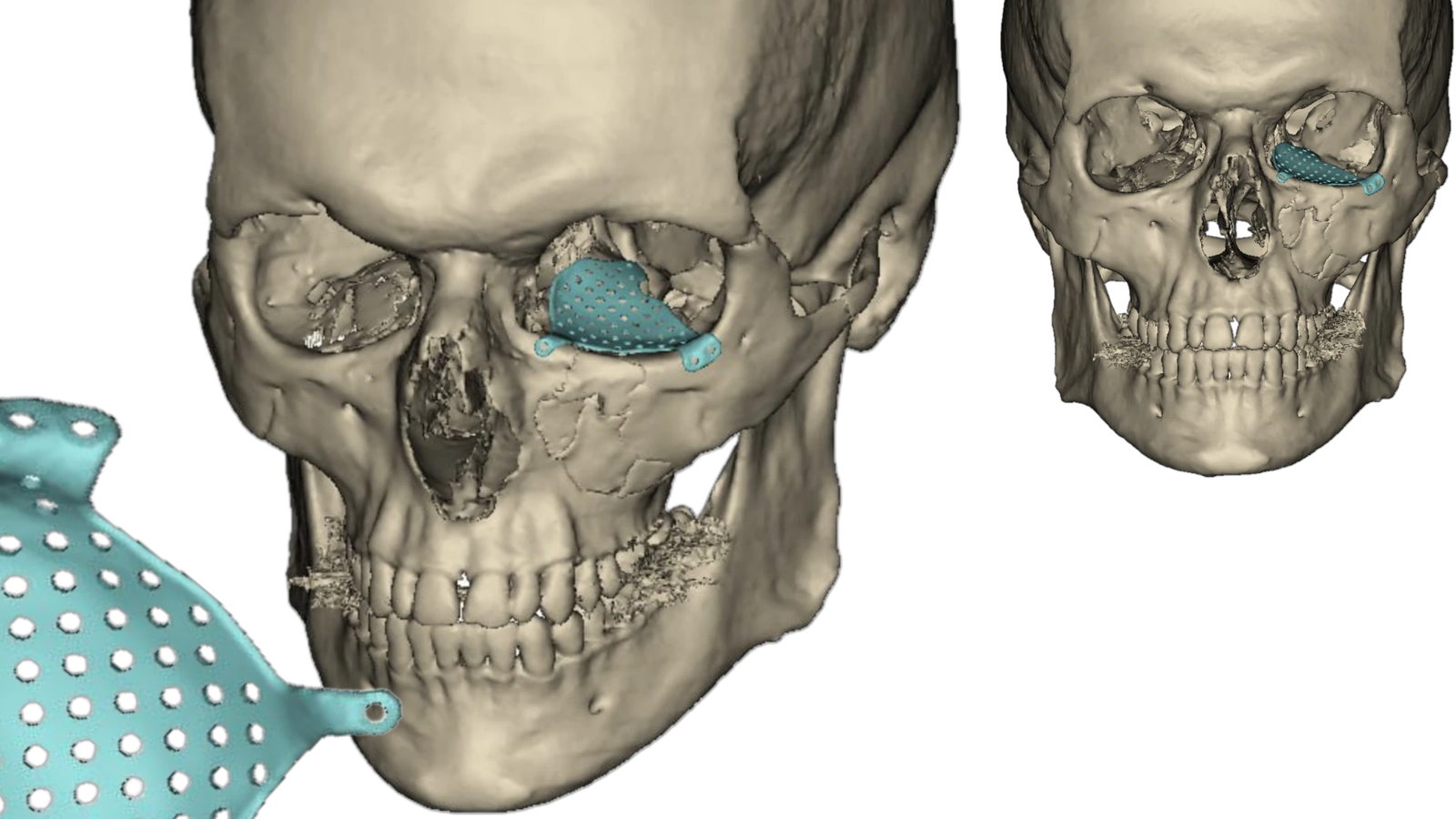
External (ecto-) prostheses are needed where surgical reconstruction is impossible or inappropriate — full loss of the auricle, total nasal resection, large midface defects. An ecto-prosthesis attaches via medical magnets on osseointegrated abutments or, in a gentler scenario, on skin-grade adhesives.
The process is hybrid: digital and manual. First — surface 3D scanning of the orbit or defect, building a negative mould, printing the press-form. Then — casting in medical-grade silicone or acrylic. Finally — hand-painting under a microscope: iris, sclera, vascular pattern, subtle skin tones.
Every prosthesis goes through a trial fit, fit correction, and photo documentation under several lighting conditions before being handed to the patient.
Most lab patients are military with loss of an eye or fragments of the face from blast injuries. Work is coordinated jointly with the surgical team: first — defect closure and bone reconstruction, then — prosthesis fitting. All within the Doctors for Heroes programme, free for military personnel.
First consultation — examination, photo documentation, assessment of options and timelines. Military patients via Doctors for Heroes — out of queue and free of charge.
Other areas of craniofacial surgery in which Medychna Kuznya works.